Journal · 8 October 2026 · CarSeen team
How to film driving scenes: low loaders, A-frames, tracking vehicles and static set-ups
Published · Updated
Almost every script has a car scene in it somewhere: a couple arguing on the way home, a detective tailing a suspect, a band singing along to the radio. On the page it's one line. On the day it's a decision about method, and that decision shapes the budget, the schedule, the permissions and the car you cast. This guide walks through the main ways productions film driving scenes and what each one asks of the picture car.
For a vehicle that drives, arrives or carries cast through the scene, brief action vehicle hire around the method you choose.
Option 1: the actor really drives
The simplest method is to put a camera inside the car, on a mount, and let the actor drive. It suits documentary-style work, short inserts and scenes where the road itself doesn't matter. It's also the method that asks the most of everyone. The actor has to drive safely while performing, the camera operator (if there is one) has to be safely seated, and the car has to be reliable, insured for that use and comfortable for its driver.
The UK's Health and Safety Executive guidance on filming in and around vehicles says people filming from passenger seats should be properly seated with seat belts on, rather than crouching in a footwell. Equipment and operators must not obstruct the driver's view or distract their attention. If you plan to let cast drive, tell us early. Whether a given car can be driven by cast depends on the owner and the insurance in place, so we confirm it car by car.
Option 2: a low loader or process trailer
For dialogue scenes, many productions put the picture car on a low trailer towed by a camera vehicle. The actors perform while someone else does the driving, and lights, cameras and crew can sit on the loader around the car. It's the method behind a lot of the in-car dialogue you see on screen, and it lets the director run a scene several times without worrying about the actor's driving.
For the picture car, the main questions are size and weight. In London, the Metropolitan Police Film Unit's guidance on filming on the move says the loader must be able to negotiate the whole route based on its length, weight and width, and that all crew aboard must be secured while it's moving. A big American saloon on a loader takes a very different route from a Mini. Reliability matters less here, because the car's engine may not even be running. That opens up cars that would be risky to drive all day.
Option 3: an A-frame or tow rig
An A-frame tows the picture car behind the camera vehicle with its front wheels lifted or steered by the rig. It's lighter and more manoeuvrable than a full low loader, and it's often used for single-shot dialogue or cutaways. The Met's guidance notes that police presence is required if the hero car on an A-frame has a side-mounted camera that extends the width of the convoy. In general, side mounts need a police escort on public roads in London. Not every car suits being towed, so we check with owners before offering a car for A-frame work.
Option 4: a tracking vehicle
When the scene is about the car from the outside, such as a chase, an arrival or a hero shot on a country road, the camera rides on a tracking vehicle, often with a stabilised crane arm, while the picture car is driven alongside, ahead or behind. This needs a competent driver in the picture car, a rehearsed plan and a route that's safe for everyone. HSE guidance stresses using drivers with the specific competences required, building in time to plan and rehearse driving sequences, and choosing routes that allow safe run-off.
For tracking work, the condition of the car's paint and chrome matters more, because the camera will be close and the light will be moving. A car that looks fine parked in the background may need detailing before it carries a tracking sequence.
Option 5: keep the car still
Not every driving scene needs a moving car. Static set-ups put the car in a studio or on location and fake the movement with lighting, rocking and backgrounds, whether that's a green screen, projection or an LED wall. They give the most control over performance and sound and avoid public roads entirely. For the picture car, the questions become practical ones: can it get into the studio, is the interior right for close-ups, and can doors or panels be removed for camera angles? Tell us the set-up and we'll check what each owner allows.
Permissions: plan before you pick the method
If any part of a driving scene happens on a public road, it needs planning with the authorities. In London, Film London asks productions to contact the Met Police Film Unit when filming on the move with tracking vehicles, low loaders, A-frames or body-mounted cameras. The Met's on-the-move guidance says it can't make decisions until the production identifies the exact roads, and that filming on roads over 40mph may need a police presence. Traffic holds or road closures need a traffic order through the relevant authority. For a fuller guide, read our post on filming car scenes on public roads in the UK.
How the method changes the car you cast
- Real driving: prioritise reliability, comfortable controls and insurance that covers the intended driver.
- Low loader: check dimensions and weight against the loader and route. Mechanical condition matters less.
- A-frame: confirm the car can be towed safely and the owner agrees.
- Tracking: paint, chrome and glass need to be camera-ready, with a competent driver.
- Static: focus on the interior, the access route into the studio and removable parts.
Left- or right-hand drive matters for every method. It decides which side the actor sits on and how the camera sees them. American cars are mostly left-hand drive, which can be exactly right for a US-set story or awkward for a British one.
Bringing it together
Decide the method with your director and DoP first, then brief the car. When you send us a brief, tell us how each car scene will be shot. We'll shortlist cars that suit that method, with notes on size, drive side and what each owner allows. Browse picture cars, see picture car hire in London, or read about action vehicles for specialist needs.
Related: Browse picture cars for film and TV, explore period cars for film by decade and TV car hire, or read about choosing a picture car hire company and picture car rental.
Planning a car scene? Send us a brief with the scene, the shooting method and your dates, and we'll come back with picture cars that fit.
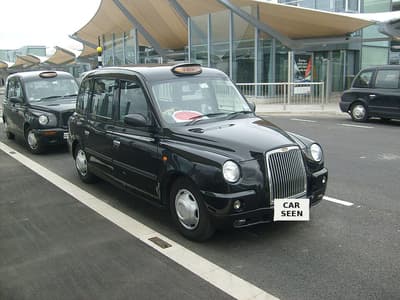
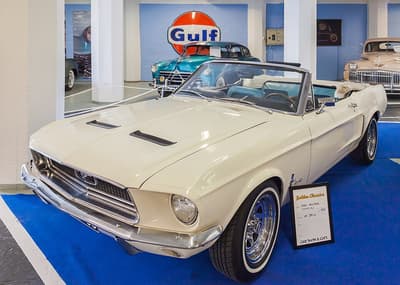
Cars featured in this guide
FAQs
How do they film driving scenes in films and TV?
The main methods are letting the actor drive with a mounted camera, towing the picture car on a low loader or A-frame behind a camera vehicle, filming from a tracking vehicle, or keeping the car still in a studio and faking the movement with lighting and backgrounds.
What is a low loader in filming?
A low loader is a low trailer that carries the picture car behind a camera vehicle, so actors can perform while someone else drives. Lights and cameras can be rigged around the car.
Do I need police permission to film a driving scene in London?
Film London asks productions to contact the Met Police Film Unit when filming on the move with tracking vehicles, low loaders, A-frames or vehicle-mounted cameras. The Film Unit needs the exact route before it can advise.
Can actors drive picture cars?
Sometimes. It depends on the car, the owner and the insurance in place. Tell us how each car will be used and we'll confirm the options car by car.
Related reading
- Picture car hire companies in the UK: how to choose
- What does a picture car coordinator do, and how do you brief one?
- Filming with police cars and uniforms in the UK: what the rules say
- ULEZ and the Congestion Charge: what period picture cars pay on a London shoot
- Number plates for filming: dating, period plates and the rules
- Period-correct cars for a 1990s or 2000s drama