Journal · 8 October 2026 · CarSeen team
Filming with police cars and uniforms in the UK: what the rules say
Published · Updated
Police cars turn up in crime dramas, soaps, comedies, commercials and music videos, and they're among the vehicles that need the most planning. A replica police car or an actor in uniform can easily be mistaken for the real thing by the public. That's why the law and the police both take an interest. This guide sets out what the public sources say, so you can plan before you book.
What the law says
Two pieces of legislation come up again and again.
Impersonating the police. Section 90 of the Police Act 1996, which applies in England and Wales, makes it an offence to impersonate a police officer with intent to deceive. It is also an offence for someone who isn't a constable to wear police uniform in circumstances where it gives them an appearance "so nearly resembling" a police officer "as to be calculated to deceive", and to possess police uniform without a lawful purpose. The Act's definition of "article of police uniform" includes anything that looks like a uniform item, badge or mark. Scotland and Northern Ireland have their own legislation, so check with the local film office if you're shooting there.
Blue lights. Regulation 16 of the Road Vehicles Lighting Regulations 1989 says no vehicle other than an emergency vehicle (or one used for special forces purposes) may be fitted with a blue warning beacon or special warning lamp, or a device that resembles one, "whether the same is in working order or not". It's one reason replica police cars are handled so carefully on public roads.
Filming in London: the Met Police Film Unit
In London (except the City of London, which has its own police), the Metropolitan Police Service Film Unit is the single point of contact. Film London's guidance says it's essential to contact the Film Unit if you're featuring fake police or military vehicles or fake police or military uniforms.
The Film Unit's published protocols for filming on location go further:
- The Film Unit must be consulted in advance of any filming that uses replica or fake police vehicles on public roads, and such filming won't be approved without Mobile Police Support.
- The Met doesn't hire out police vehicles to third parties. Productions use specialist suppliers instead.
- When a replica police vehicle is driven to and from location on public roads, the protocols list steps to stop it being mistaken for a real one. External "POLICE" graphics are taped over. Light bars and beacons are covered. Sirens and tones aren't used. The driver must not wear police uniform in transit. Productions are also advised to consider transporting the vehicle on a low loader.
- The protocols also cover filming with actors or extras in police uniform, which needs the same advance consultation.
The Film London Code of Practice also expects productions to tell the Film Unit about staged crimes and scenes involving fake police officers or vehicles.
Outside London
The Met's protocols apply to London. Elsewhere, contact the local police force and the local authority's film office before the shoot, and treat the Met's approach as a sensible benchmark: tell them in advance, cover markings and lights in transit, keep uniforms off the public highway between takes and consider a low loader. Regional screen agencies can point you to the right contacts.
Practical planning checklist
- Decide where the police vehicle appears. On private land or a closed set, the planning is simpler. On a public road, plan for police involvement from the start.
- Tell the police early. The Film Unit, or the local force outside London, needs dates, locations, the vehicles and the scenes.
- Get the era right. British police liveries changed over the decades, and audiences notice. A 1970s scene needs a period panda car, not today's high-visibility livery. Tell your supplier the year and region of the story.
- Plan transport. A low loader avoids most of the in-transit risk and covering work.
- Brief cast and supporting artists. Uniforms stay on set. No one should wear them on the street between takes or while travelling.
- Agree who covers and uncovers. Assign someone to cover markings, light bars and beacons whenever the vehicle isn't in shot on a public road.
- Think about the public. Signage and stewarding help people nearby understand it's a film shoot.
Background police vehicles
The same thinking applies when police vehicles are only in the background, such as a parked patrol car at a crime scene or a van at the end of a street. Members of the public can't tell a background prop from a real incident, so treat background vehicles with the same care as featured ones. Include them in your notifications to the police and the film office, and in your risk assessment.
Choosing the right police vehicle
Picture-car police vehicles range from genuine ex-service cars to replicas built for screen, and from 1960s pandas to modern interceptors and American cruisers for US-set stories. Our police and emergency vehicles page shows what's in the CarSeen catalogue, and our action vehicles page covers other specialist vehicles. Shooting in the capital? See picture car hire in London for permissions and logistics.
Match the vehicle to the story as closely as you can. Police liveries, equipment and models changed over the decades and varied between forces, so tell us the year and the force area your scene is set in, and gather reference photos early. Ask the force's film unit, or the local police, how markings should be handled when the vehicle is travelling to and from set, and build covering or uncovering time into the schedule if needed.
This article summarises public guidance and legislation for planning purposes. It is not legal advice. Always confirm the current requirements with the relevant police force and film office for your shoot.
Related: Browse picture cars for film and TV, explore period cars for film by decade and TV car hire, or read about choosing a picture car hire company and picture car rental. For vehicle options, read police car hire for filming.
Need police or emergency vehicles for a shoot? Send us a brief with the period, the location and how the vehicle will be used, and we'll flag the practical points for each option.
Cars featured in this guide
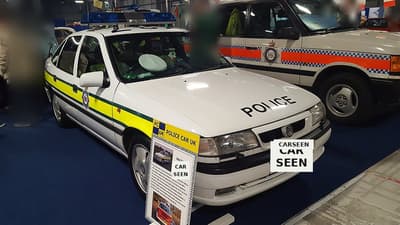
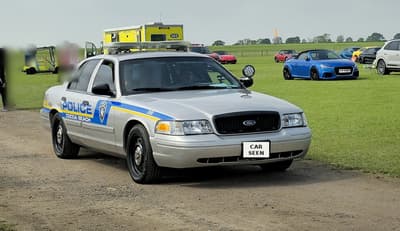
FAQs
Is it legal to use a fake police car in a film in the UK?
Yes, productions regularly use replica police cars, but it needs planning. In London the Met Police Film Unit must be consulted in advance of filming with replica police vehicles on public roads, and such filming won't be approved without Mobile Police Support.
Can actors wear police uniform for filming?
Yes, with care. Section 90 of the Police Act 1996 makes it an offence to wear police uniform in a way calculated to deceive, so uniforms should stay on set. In London, the Met Police Film Unit asks to be consulted about filming with actors or extras in police uniform.
How should a replica police car travel to set?
The Met's protocols say police graphics should be taped over, light bars and beacons covered, no sirens or tones used, and the driver not in uniform. Transporting the vehicle on a low loader is also recommended.
Can I hire a car from the police for filming?
The Met's protocols state that it does not hire out police vehicles to third parties. Productions use specialist picture-vehicle suppliers.
Related reading
- Picture car hire companies in the UK: how to choose
- How to film driving scenes: low loaders, A-frames, tracking vehicles and static set-ups
- What does a picture car coordinator do, and how do you brief one?
- ULEZ and the Congestion Charge: what period picture cars pay on a London shoot
- Number plates for filming: dating, period plates and the rules
- Period-correct cars for a 1990s or 2000s drama